 TLG Solutions LLC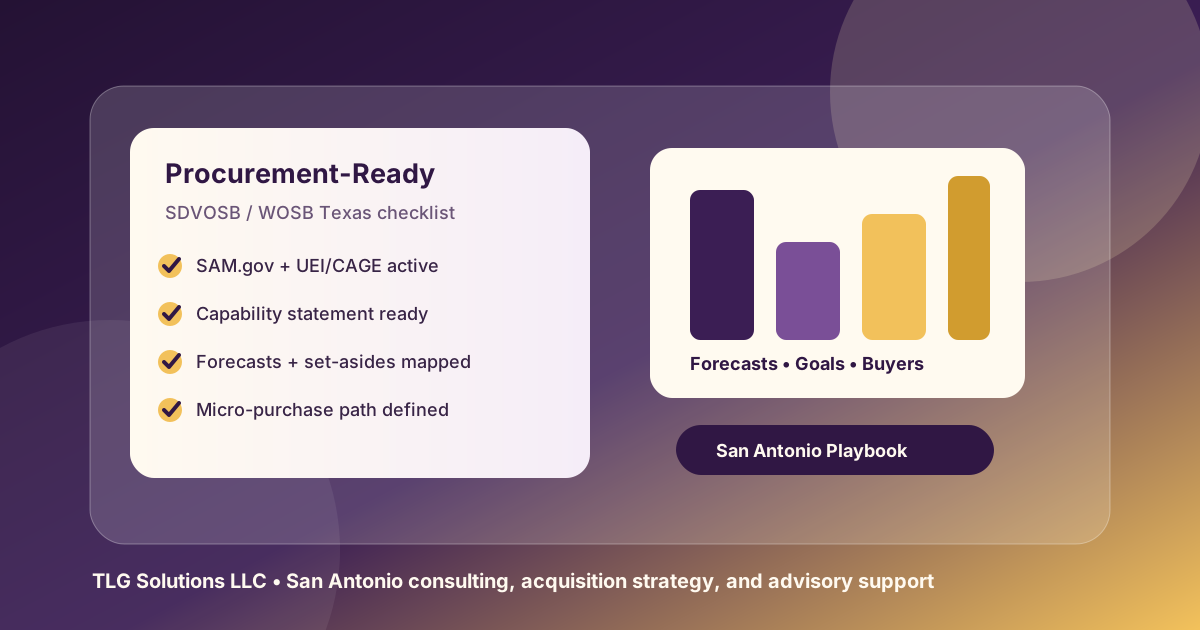
Texas SDVOSB and WOSB firms can miss contract conversations even after certification if their public records, capability statement, buyer research, and follow-up plan are not ready when an opportunity opens.
This guide turns the readiness work into a practical San Antonio playbook for small-business owners preparing to compete for federal, Texas, local, and micro-purchase opportunities.
- In FY25, SBA reported nearly 28% of federal prime contract dollars went to small businesses, exceeding the 23% statutory goal.
- A procurement-ready firm needs active registration data, a buyer-focused capability statement, and a target list before outreach.
- San Antonio firms should pair federal tools with City, SAWS, River Authority, Supply SA, and UTSA support resources.
What does procurement-ready mean for SDVOSB/WOSB firms?
In 2026, a procurement-ready Texas SDVOSB or WOSB is more than certified. It has active SAM.gov data, correct UEI/CAGE identifiers, clear NAICS alignment, buyer-ready proof of services, and a one-page capability statement that can be used in federal, Texas, and local conversations.
Certification matters, but buyers still need evidence that the company can perform. TLG Solutions can help small firms turn credentials into a practical acquisition strategy: which buyers to track, which service lanes to package, and how to show experience without overclaiming.
The same structure also helps advisors and business owners clarify which support they need: acquisition planning, market research, operational support, business guidance, notary availability, or disciplined coordination around the next buyer conversation.
Why is procurement readiness a stronger topic than certification alone?
In FY25, SBA reported that the federal government awarded nearly 28% of prime contract dollars to small businesses, or about $179 billion in prime dollars. That opportunity favors firms that can be found, verified, and quickly evaluated by buyers.
Many guides explain certification rules. Fewer combine certification, capability statements, forecast research, and buyer outreach in one San Antonio-focused plan. A readiness guide closes that practical gap for owners who need the next action, not just another definition.
Procurement teams often need concise answers. They want to know what a business does, where it fits, whether it has the identifiers required to buy, and whether the company can respond professionally. A readiness checklist gives them that signal.
What should be in the first 30 days of a 90-day readiness plan?
The first 30 days should confirm registrations, identifiers, size standards, NAICS codes, certifications, and contact data. Federal small-business procurement goals include 23% for small businesses, 5% for WOSBs, and 5% for SDVOSBs, so clear eligibility matters.
Do not stuff every possible service into one document. Buyers need a crisp match between the problem, the purchase path, and the company’s ability to deliver.
How should a capability statement support SDVOSB/WOSB outreach?
A capability statement should be a one-page buyer screen, not a brochure. HHS, GSA, and GovCon guidance consistently emphasize core competencies, differentiators, company data, past performance, and direct contact information.
For advisory and professional support work, the strongest capability statement connects strategy to outcomes. A buyer should quickly see acquisition planning, market research, operational support, leadership guidance, notary availability, and coordination capacity.
Use a consistent “buyer-first” structure:
| Section | What it should answer |
|---|---|
| Core competencies | What can the firm do without ambiguity? |
| Differentiators | Why choose this firm for this buying need? |
| Past performance | What comparable experience or representative work lowers buyer risk? |
| Identifiers | Which UEI, CAGE, NAICS, certifications, and contact details help procurement verify the firm? |
Where should San Antonio firms research 2026 opportunities?
San Antonio firms should combine federal and local forecast sources. The City of San Antonio publishes anticipated solicitations, while SAWS, the San Antonio River Authority, Supply SA, UTSA, GSA, and SAM.gov add buyer-specific signals.
A practical research routine is simple: check forecast pages monthly, record buyer names and quarters, map each opportunity to NAICS/service lanes, and decide whether the next action is relationship-building, teaming, capability-statement revision, or no-bid.
Local research is also a credibility signal. When outreach references the buyer’s own forecast language, it sounds prepared instead of generic.
How can consulting, notary, and advisory services fit micro-purchases?
Micro-purchase and low-friction buying paths often reward clearly packaged services. A firm can frame consulting, notary, training, process improvement, and acquisition support as defined units with scope, deliverables, timing, and contact steps.
That does not mean every service belongs in federal contracting. It means each service should have a buyer-ready package: what is included, who needs it, when it is useful, what documentation supports it, and how a buyer can request it without confusion.
For example, mobile notary services can support local professional needs, while acquisition support and capability statement guidance can support business owners preparing to sell to agencies or primes.
What should the next 60 days include?
Days 31 through 90 should turn readiness into action. Build a target-buyer list, review upcoming forecasts, update the capability statement, prepare outreach language, and track responses so the business can learn which service lane gets traction.
- Days 31-45: choose five buyer targets and match each to one service lane.
- Days 46-60: tailor the capability statement and outreach note for each target.
- Days 61-75: ask about forecast timing, vendor events, and subcontracting paths.
- Days 76-90: refine the pitch, package micro-services, and build a quarterly follow-up calendar.
Need a buyer-ready next step?
TLG Solutions LLC helps small businesses organize strategy, procurement readiness, acquisition support, operations, and practical next steps. Review the consulting and advisory services, confirm buyer credentials in the capability statement, or contact Tina L. Green to discuss the right path.
Frequently asked questions
What does procurement-ready mean for a Texas SDVOSB or WOSB?
It means the company has verified identifiers, active registrations, accurate certifications, clear service categories, a capability statement, target-buyer research, and a practical follow-up plan.
Does a capability statement replace SAM.gov or certification?
No. SAM.gov and certifications help buyers verify eligibility. A capability statement helps buyers understand what the firm can do and whether it fits the opportunity.
What local sources should San Antonio businesses monitor?
Monitor the City of San Antonio procurement forecast, SAWS, the San Antonio River Authority, Supply SA, UTSA contracting support, SAM.gov, and GSA forecast tools.
Sources and retrieval notes
- SBA, “SBA Releases FY25 Scorecard for Small Business Contracting,” retrieved 2026-07-03, https://www.sba.gov/article/2026/06/25/sba-releases-fy25-scorecard-small-business-contracting
- SBA, “Small Business Procurement,” retrieved 2026-07-03, https://www.sba.gov/partners/contracting-officials/small-business-procurement
- City of San Antonio, “Anticipated Solicitations / Annual Procurement Forecast,” retrieved 2026-07-03, https://www.sa.gov/Directory/Departments/Finance/About/Divisions/Procurement/Bidding-Contracting/Anticipated-Solicitations
- HHS, “Write a Capability Statement,” retrieved 2026-07-03, https://www.hhs.gov/grants-contracts/contracts/get-ready-to-do-business/write-a-capability-statement/index.html
- GSA, “Get Started With Government Contracting,” retrieved 2026-07-03, https://www.gsa.gov/small-business/get-started
- Supply SA, certification and local business support resources, retrieved 2026-07-03, https://supply-sa.org
- UTSA Today, “Center for Government Contracting enhances small business support,” retrieved 2026-07-03, https://news.utsa.edu/2025/07/center-for-government-contracting-enhances-small-business-support/
A procurement-ready Texas SDVOSB or WOSB should be findable in public systems, clear about its service lanes, supported by a buyer-focused capability statement, and disciplined about tracking federal, Texas, and San Antonio opportunity forecasts before outreach begins.